Learn to reason through complex diabetes cases.
Glycemic Pathway is an interactive educational simulator for internal medicine residents, endocrinology trainees, and medical educators. Work through fictional diabetes cases, examine incomplete or conflicting information, and explore the guideline-based reasoning behind each step.
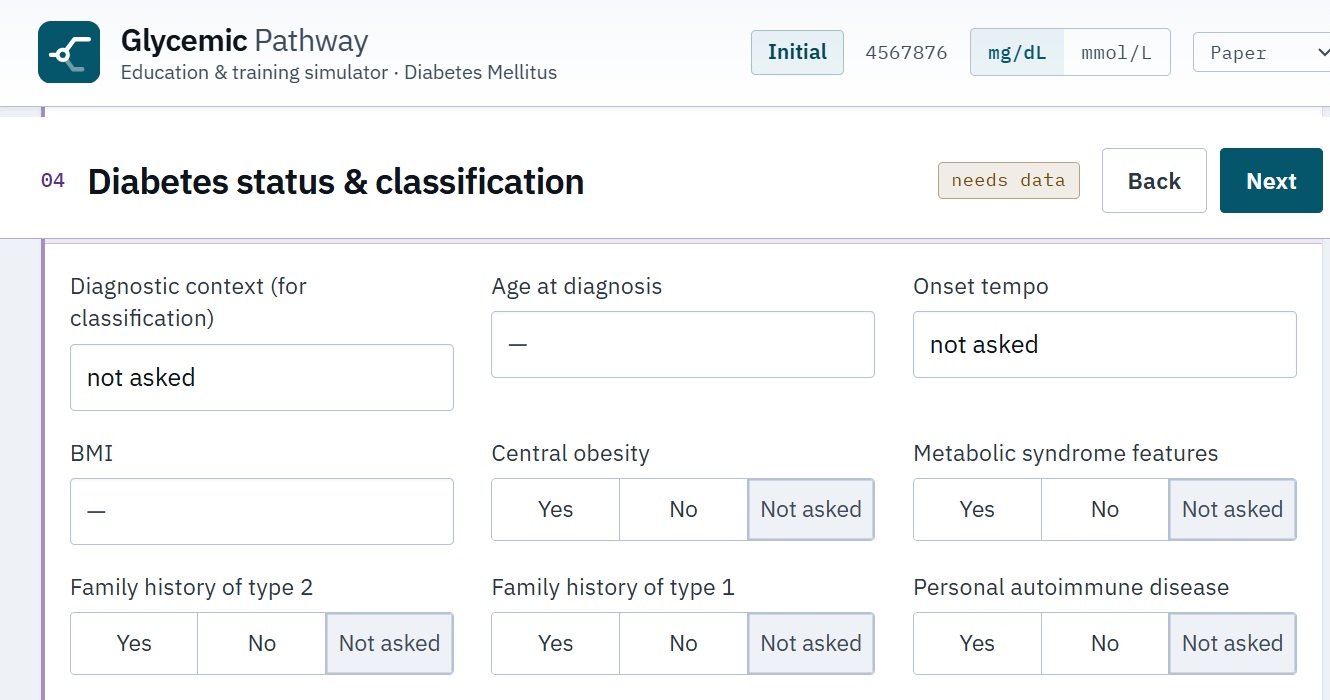
What working through a case actually looks like
These are real screens from the live simulator (with a fictional test patient) — not illustrations.
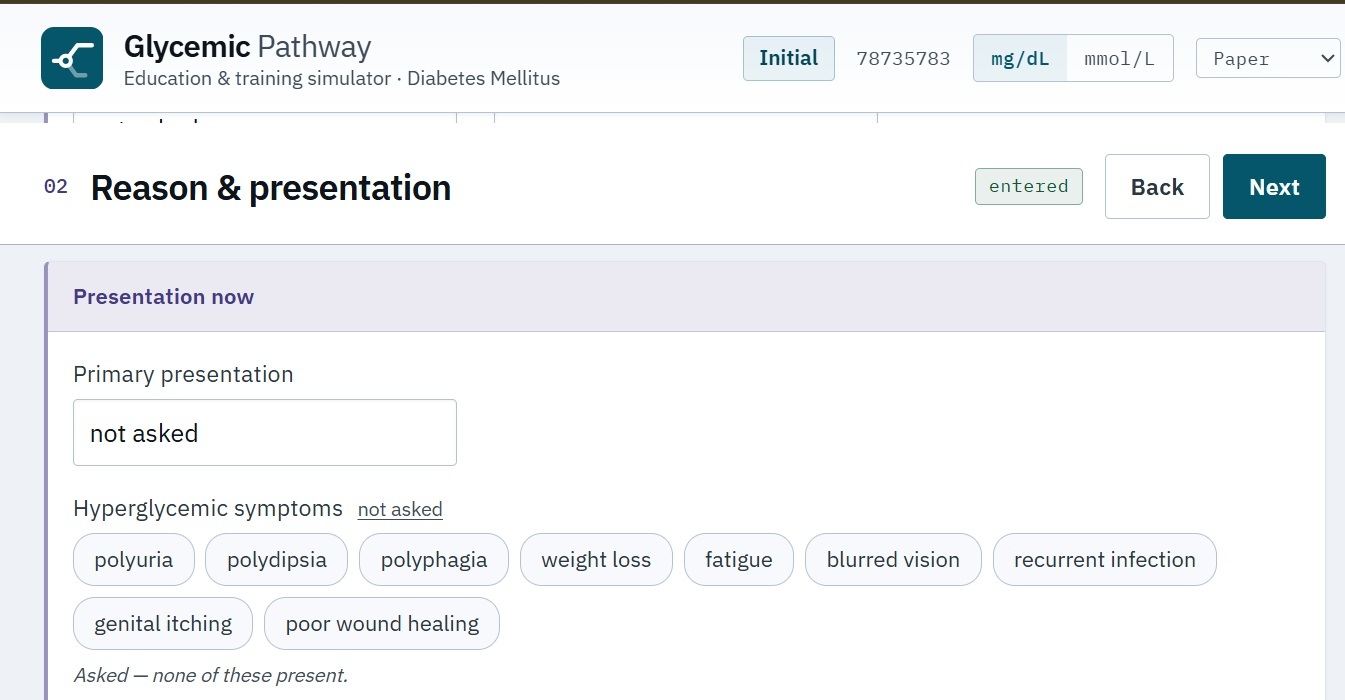
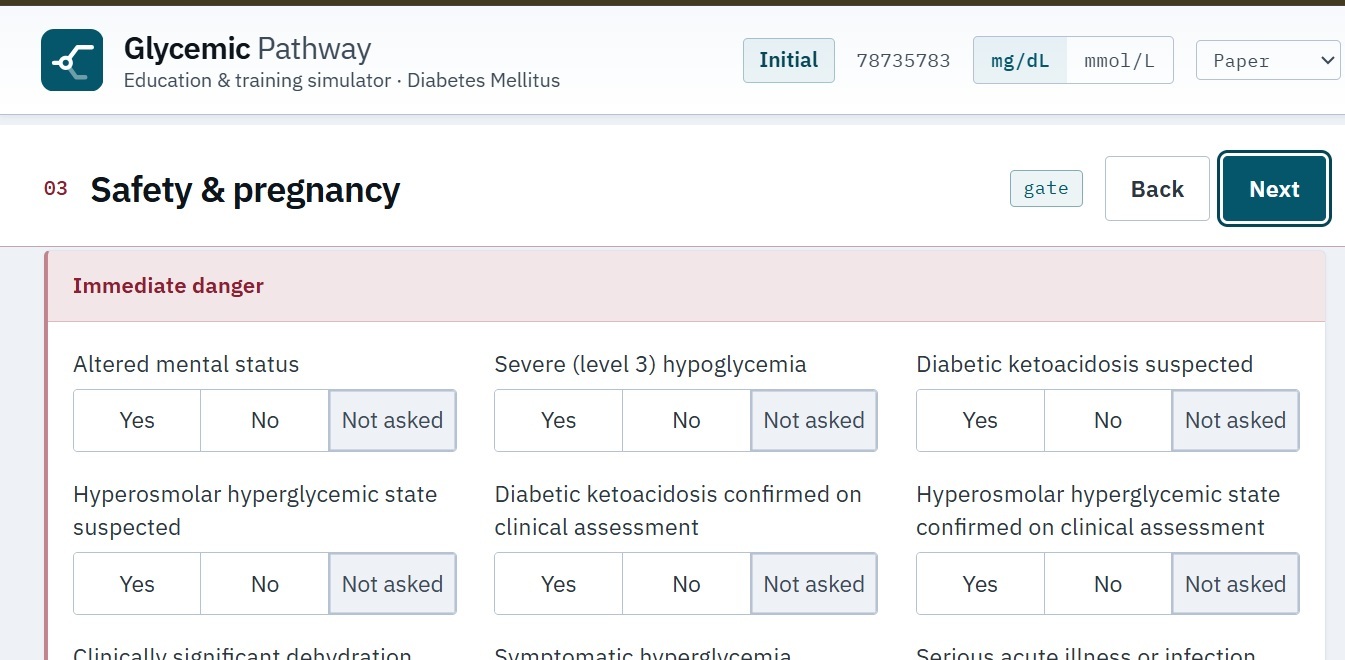
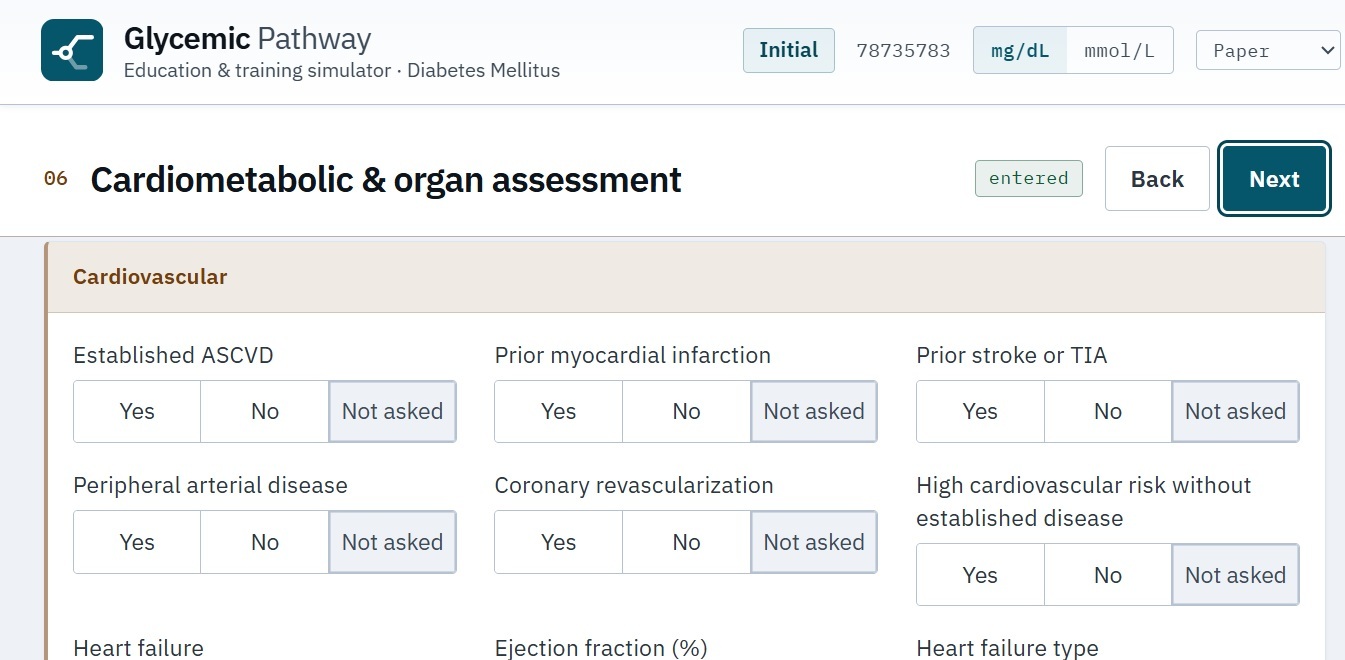
From an empty chart to a reasoned plan
Open a case
Pick an encounter type — initial, interval, follow-up, or pregnancy-adjusted.
Decide what to ask for
You choose which history, labs, and exam findings to gather — nothing is handed to you upfront.
Work through conflicts
Cases include ambiguous or missing data and competing considerations, the same way real charts do.
See the reasoning trace
Every recommendation traces back to the specific rule — indication, exclusion, or population — that produced it.
Built around clinical reasoning, not quiz questions
Branching patient scenarios
Cases adapt to the data you gather, including ambiguous labs, missing values, and conflicting history — the situations guidelines alone don't resolve for you.
Transparent rule-by-rule reasoning
Every recommendation traces back to the specific indication, exclusion, or population rule that produced it, so you can see exactly why, not just what.
Four clinical pathways
Initial, interval, follow-up, and pregnancy-adjusted encounters, each asking genuinely different questions — plus logic covering renal function, cardiovascular and heart-failure history, and cost/access constraints.
Built for people learning or teaching diabetes management
Internal medicine residents
Practice guideline-based decisions outside of clinic hours, at your own pace.
Endocrinology fellows
Work through harder edge cases — CKD, ASCVD, heart failure, pregnancy — repeatedly.
NP/PA trainees
Build the same guideline-reasoning habits alongside your program's own teaching.
Program directors & educators
A Team plan gives a training group shared access for structured group practice.
What the reasoning is built on — and what it isn't
Guideline sources
Case logic draws on published sources including the ADA Standards of Care, the ADA/EASD consensus on type 1 diabetes, AACE's treatment algorithm, KDIGO (CKD), ACC/AHA guidance on lipids and hypertension, and FDA prescribing information for the medication classes involved.
Educational limitations
This is a training simulator designed to build clinical reasoning skills for the management of diabetes. It does not replace a physician, and every case is fictional or de-identified. See the full disclaimer.
Individual and Team plans, billed monthly, every 6 months, yearly, or once
Every plan includes the same simulator and the same case logic — the only differences are who it covers and how you pay.
6-monthly, annual, and lifetime options are also available — see exact prices and a full comparison on the pricing page.
Common questions
Is this accredited for CME or CE credit?
No. Glycemic Pathway is an independent practice tool for self-study and group training — it does not currently offer CME/CE credit.
Can I get a refund if it's not for me?
Yes — see the refund policy for the exact window and conditions.
How many cases are there?
Cases are generated from patient data you enter across four pathways (initial, interval, follow-up, and pregnancy-adjusted), with branching logic covering comorbidities like CKD, ASCVD, heart failure, and cost/access constraints — rather than a fixed, countable question bank.
Does my program need to approve this?
No approval is required to use it individually. If you want a Team plan for your program, your program director or chief resident can set that up and invite the group.
Can I cancel anytime?
Yes, on any recurring (Monthly, 6-Monthly, or Annual) plan — you keep access until the end of your current paid period. Lifetime plans are a one-time payment with nothing to cancel.
Who built this?
Glycemic Pathway was built by a physician with direct clinical experience in diabetes care, combined with software engineering to turn published guidelines into an interactive reasoning exercise.